
Every day … for now … is a struggle to stay in the Pursuit. But of course, I know it’s the enemy waging his battle. And just as soon as the Holy Spirit brings that to my attention the struggle lessens.
I’ve always loved reading, and the majority of what I read is fiction, Christian suspense for the past few years, nothing but science fiction some decades back.
During the last few weeks I’ve read science fiction again. Some of it has been pretty good, like the Colony Mars series by Gerald M. Kilby … pretty fun read. Then I started The Long Winter trilogy by A.G. Riddle. It started out good and I enjoyed the first two books. But probably halfway through the third book it started getting so “out there” … It was as though the author was flashing back to his LSD days … and I stopped reading it. Not interested.
I thought to myself, “Maybe it’s time to refocus on learning more about God, praying, and surrendering myself to Him.
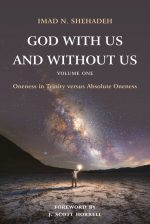
So I went to my tablet’s Bible, Olive Tree Study Bible, where I have several books in addition to Bibles — many devotionals, some theology, many many “Christian living”. I saw an ad in the Olive Tree app for “God With Us and Without Us, Volume One: Oneness in Trinity versus Absolute Oneness” by Imad N. Shehadeh. After reading a sample in Amazon’s Kindle I decided to buy it. The author begins the Introduction by titling it Passion for the Trinity, with the first paragraph saying:
This study is an appeal to join a journey of reflection on and discovery of the true and eternal nature of God in the midst of many untrue voices about him.
That sure whet my appetite.
The first chapter then begins with the title Readiness to Receive God’s Revelation of Himself, and continues with elements that prepare us for this revelation. These elements are:
- The Fountain of All Thought about God is the Bible
I certainly understand that! - The Christian message begins with the Gospel
In my mind, the Gospel is where we find what defines Christianity - The doctrine of the Trinity is not confined to the word “Trinity”
After all, the word “Trinity” is not found in the Bible - The finite cannot see all of the infinite
Here is where I started to see something profound phrased how I haven’t seen it before. [More later, because this editor won’t let me insert a quote in a numbered list.] - What is necessary is often unseen
“A person does not often consciously or continually think to this depth” (what may be the subconscious) - The Trinity is not a problem to be solved
“The doctrine of the Trinity is not a problem to be solved but rather a beauty to be discovered.” I love that. - There is need for depth behind simplicity
The simple message “Christ died for all people” contains much deeper truths behind it! - Freedom from confining thinking about God’s Oneness
This relates to the author’s discussion about “Absolute Oneness” — the belief of those that don’t accept the doctrine of the Trinity — as opposed to “Oneness in Trinity”, the doctrine that Christians hold as true: three Persons in one God. - Theological preparation in the progress of Revelation
It was here that my eyes began to glaze over, exceeding the capacity of my brain to digest the much deeper discussion the author continues. I’ll continue later after I give my brain a rest.
Returning to what I mentioned in #4 above, what I consider the most substantial point — to me — presented in the first chapter of this book:
God is much bigger than can be imagined by any human being! It is impossible for a finite man or woman to comprehend all of the infinite God. Therefore it is expected that we will find difficulty when first hearing about the doctrine of the Trinity. As an illustration of this, because of our limited sight, we are unable to see both sides of a coin at the same time. We can see only one side then the other. Likewise, our limited comprehension allows us to see one side of God, then another, then another, and so on, but never to see all sides at the same time.
And he continues:
Another illustration is to imagine two worlds: one that is three-dimensional, with length, width and height; and one that is two-dimensional, with length and width only. The two-dimensional world sees a cube as a square, and a ball as a circle. This is because the common intersection is only two-dimensional. This is similar to what happened to Christ when he came to earth. It is impossible for human beings, who are limited in dimensions, to comprehend all of God who is infinite in dimensions. We can only experience one specific aspect of God, then another, then another, and so on. For if God was small enough to be comprehended, he would not be big enough to be worshiped.
I’ll say it again — “For if God was small enough to be comprehended, he would not be big enough to be worshiped.”